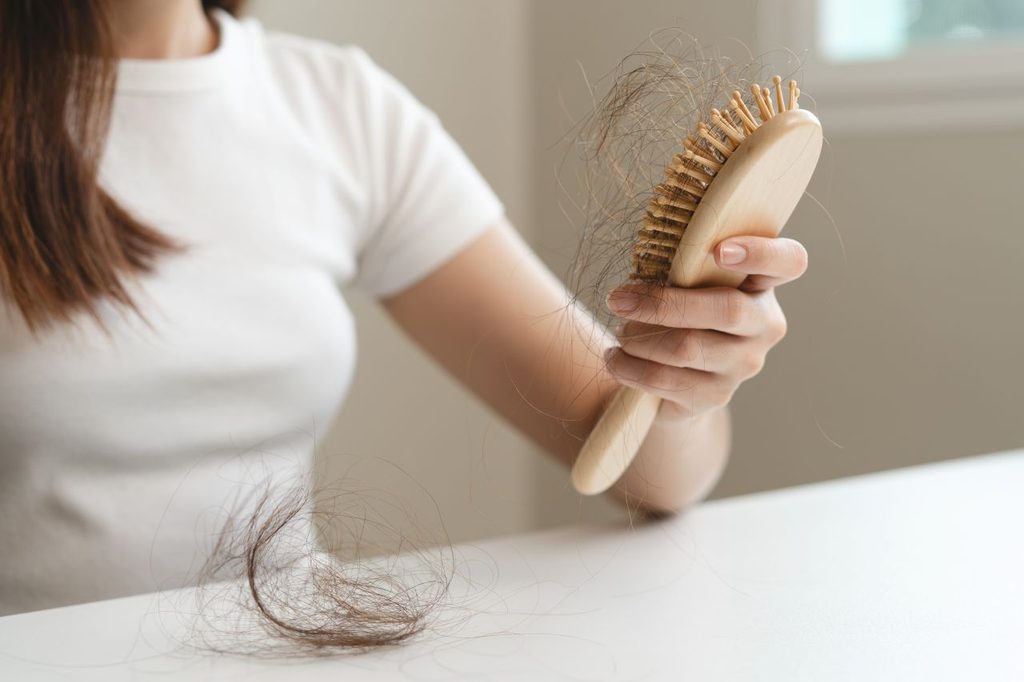
While shedding is a completely natural part of the hair growth cycle, hair loss is a completely different ball game. Partial hair loss is more common than you might think here in the UK, with several causes attributed to the partial loss or thinning of hair. Everything from tension, stress and poor diet to autoimmune issues and infection can result in partial hair loss, and unfortunately, it can strike at any age.
Alopecia areata is the most common type of partial hair loss condition, here NHS Inform explains the tell-tale signs to watch out for:
“It usually causes small, round patches of baldness on the scalp. However, it can affect other areas including the eyebrows and eyelashes. In some people, it can affect larger areas including the entire scalp or the entire scalp and body. It’s not possible to tell how much hair you’ll lose, or how quickly it’ll grow back. There’s also a risk that new patches of hair loss will develop in the future. Hair can sometimes regrow white.”
Whether you have temporary partial hair loss and expect regrowth or are managing a longer term condition, being able to rely on a wig during your recovery could be a positive step in the right direction. But, which wig should you choose?
Not necessarily – if hair loss is confined to one or two areas, as it so commonly is with several partial hair loss conditions, a topper or hairpiece may provide all the coverage you need.
Toppers are designed specifically to cover areas such as the crown, parting or top of the head while allowing your existing hair to remain visible. Colour matching your hairpiece for a natural blend however is recommended.
Not always! A full wig becomes the better option when thinning or hair loss affects multiple areas, or when there isn’t enough healthy hair to create a convincing blend. Some partial hair loss sufferers prefer a full wig for the complete coverage offered too.
A topper on the other hand can be an excellent solution if you have sufficient healthy hair around the area being covered. If your remaining natural hair is very fine, fragile or continuing to fall out, attaching a topper with clips or combs may put additional tension on those delicate areas and negatively impact the road to recovery.
Poorly fitted or heavy toppers can be extremely damaging to your natural hair, with the excessive tension and repeated pressure from clips actually contributing to further hair loss.
If you prefer the complete coverage, would rather not blend your natural hair, want a particular hairstyle, or know that your hair loss is worsening, a full wig may be the better choice for you, even if you have lots of natural hair at the moment.
The key to wearing your wig well is preparation. Your natural hair should be secured to provide a flat, solid foundation to apply your wig and achieve the finish you desire.
Those experiencing partial hair loss may need to shop for their wig a little differently. When selecting a wig for partial hair loss, it’s all about how the cap interacts with your remaining natural hair. With this in mind, many prefer the lightweight and breathability of open or wefted caps.
For a discreet finish, a monofilament cap can deliver a realistic looking scalp as well as a whole range of styling options thanks to its ultra flexible parting. Lace front designs are also top picks for their natural looking hairlines.
Here at Wigs4u, we have a selection of full wigs and hairpieces to choose from. Browse our online shop to find exactly what you’re looking for.
 Fast Dispatch, everytime you place your order before 1pm (Monday–Friday) and we’ll aim to process and dispatch it the same day via Royal Mail Signed-For service. Please note: Weekend orders and those with out-of-stock items may take a little longer If there’s a stock issue, we’ll get in touch right away—just make sure your contact details are up to date!
 Thanks for choosing Wigs4U—we’re here to make wig shopping simple, fast, and fabulous!
