Wigs are well known and much loved for their outstanding versatility, with wearers able to explore a variety of styles and shades without any permanent changes at all. Alternating between a straight style and a curlier look is one thing many people indulge in, and just like your natural hair, the technique you use to achieve each deserves careful consideration.
Read on for a definitive guide to what’s safe when straightening or curling a wig – and what’s not.
While there is such a thing as heat styleable wigs, we’d always recommend heat-free curling and straightening methods as a general rule, particularly when you want to preserve the condition and longevity of your wig.
Both human hair and synthetic wigs are susceptible to heat damage. While the former offers considerably more styling versatility, the repeated use of heated styling tools can result in irreversible dryness and brittleness. Synthetic fibres can be even more vulnerable to heat, with excessive temperatures potentially melting, scorching, shrinking or permanently altering the very fibres of the wig.
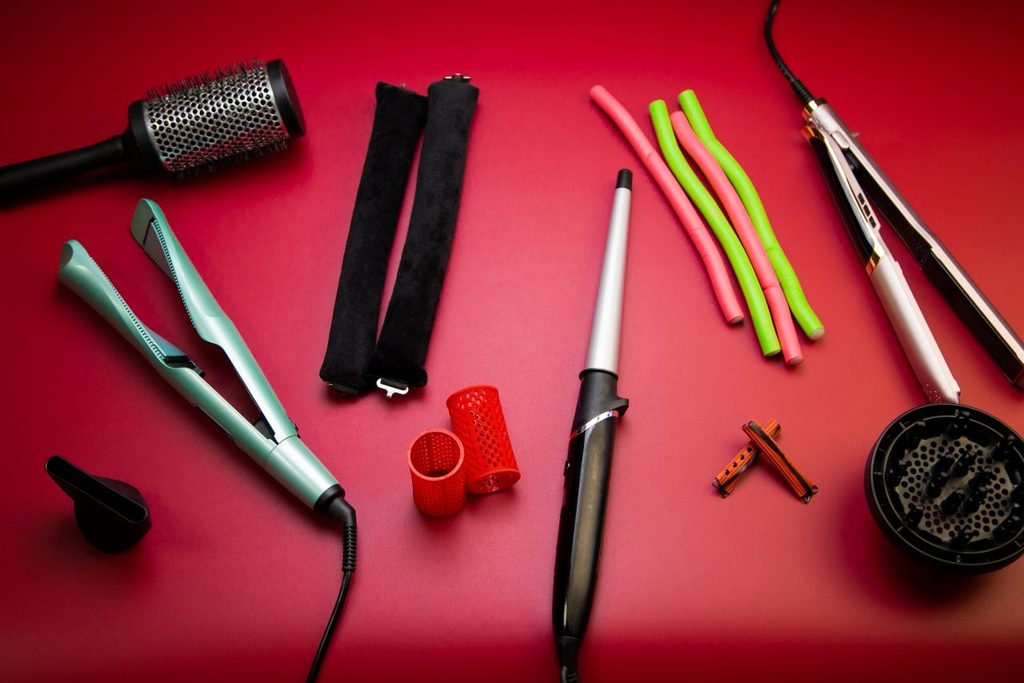
If in doubt, leave heat out by avoiding curling irons and wands, traditional heated rollers, straighteners and hairdryers.
Foam rollers are one of the gentlest ways to introduce curls or waves to your wig – and they require absolutely no heat at all! The size of the rollers can also be customised to ensure a look you love. Small rollers for instance produce tighter curls, whilst large foam rollers are perfect for loose waves and extra volume.
Simply wrap sections of your wig around the rollers. This technique works better when the wig is slightly damp, with the wig needing to dry completely before roller removal. Flexi rods work in a similar way and are equally heat-free, the only difference being they are known to deliver more defined curls and a more uniform result. Heatless curling ribbons on the other hand produce looser curls and voluminous waves.
The objective of heat protection sprays may be an admirable one, but it is important to bear in mind that not all heat protection sprays are suitable for wigs. Here at Wigs4u, we recommend using only products specifically designed and approved for use with wigs, whatever their purpose.
Using a heat protection product also doesn’t automatically make heat styling safe. We’ll let Beauty Nexus Pro explain more:
“No product can override physics. Heat protectants form temporary thermal barriers and reduce moisture loss—but they don’t raise a fiber’s intrinsic melting point. Applying spray to a 250°F PET wig and using a 350°F iron still guarantees deformation. Protection only works within the fiber’s native thermal window.”
If you’re styling a human hair wig with heat, a suitable heat protection product may help to reduce the effects of heat on the hair. It won’t however eliminate the risk of damage completely, particularly with frequent or high-temperature styling.
Wet setting is another heatless technique that uses rollers, but this time to achieve a sleeker, smoother finish. Best performed post wig washing, wet setting involves gently combing and detangling fibres, applying mousse or another wig safe smoothing product, inserting rollers in small sections and leaving it to dry naturally. Once dry, the rollers are removed to reveal a straighter look that can last for several days.
Patience is the final ingredient needed to wet set your wig; avoid trying to speed up the process with heat.
While loose braids are great for adding waves to a wig without heat, you should steer clear of tighter braided styles left in for unnecessarily long periods of time as they can damage wig fibres and cause tension. Secure your loose braids just as gently with soft, snag-free hair ties. Take extra care when undoing your braids too, avoiding pulling and tugging.
Looking for a wig you can style your way? Explore our range of quality men’s and women’s wigs today at Wigs4u.
 Fast Dispatch, everytime you place your order before 1pm (Monday–Friday) and we’ll aim to process and dispatch it the same day via Royal Mail Signed-For service. Please note: Weekend orders and those with out-of-stock items may take a little longer If there’s a stock issue, we’ll get in touch right away—just make sure your contact details are up to date!
 Thanks for choosing Wigs4U—we’re here to make wig shopping simple, fast, and fabulous!
