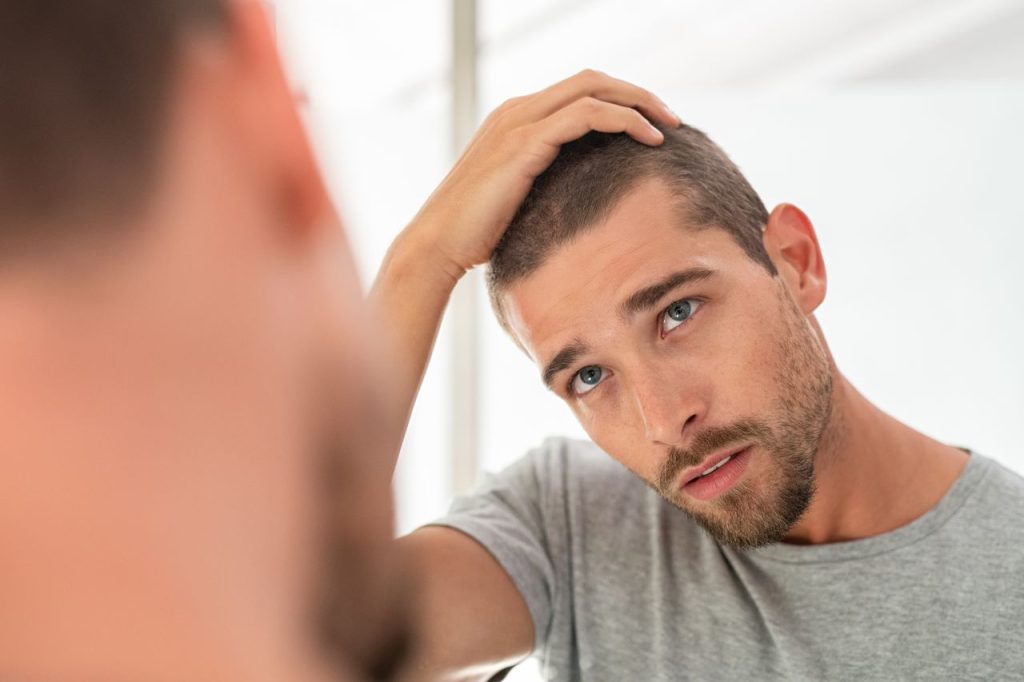
While the middle hairline – a hairline type that sits in the middle of the forehead – is considered the most common, it is important to acknowledge that hairlines come in all shapes, sizes and styles. From the iconic widow’s peak and cowlick to the low, high and bell-shaped hairline, each is as distinctive as the last.
Whether it’s genetics, ageing, hormones or your styling preferences that have shaped yours over the years, understanding what’s normal for you and your hairline is vital. Read on to discover the signs that your hairline is receding and what you can do to get things back on track.
One of the first places those with receding hairlines will experience thinning is just above the temples. In men, and cases of male pattern baldness, the hair will continue to thin backwards until the sides and back of the head become bare.
This pattern of recession and thinning differs for female sufferers however as the British Association of Dermatologists details:
“Patterned hair loss looks different in males and females. In females, there is widely spread thinning of the hair, mainly on the crown of the scalp. The hairline at the front of the scalp often remains normal. Hairs in the affected areas are initially thinner (smaller in diameter), and shorter compared to hairs in unaffected areas, before they become absent.”
Unfortunately, genetics has a part to play in your risk of developing a receding hairline. Men who have a family history of baldness will find they are more likely to suffer the same fate, although the timing of hair loss or thinning differs from person to person.
Hormonal fluctuations have also been linked to receding hairlines, with both menopause and pregnancy causing hormone-related hair loss or thinning for some individuals. Menopausal hair loss for instance often results due to the decrease in estrogen and progesterone, and the increase of male hormone androgen.
While receding hairlines caused by menopause, pregnancy, thyroid issues, or other events or conditions that cause hormone imbalances tend not to be permanent, taking steps to help your hair recover is recommended.
Certain medications and supplements have been identified as causes of receding hairlines and other instances of hair loss and thinning.
Medication used to treat gout, heart issues, high blood pressure and depression have seen those affected suffer from hair loss related side effects. While drugs used to manage longer term ailments such as arthritis have also had a less than desirable impact on the hairline. Treatments, such as radiation therapy and surgery, could be responsible for your receding hairline too.
As with any type of hair loss or thinning, your treatment options – and their success – are dependent on the underlying cause. With this in mind, establishing the cause of your receding hairline sooner rather than later will help you determine whether hairline thinning is permanent or temporary, and if treatment will be effective.
For those with temporary hair loss and thinning, our synthetic and human hair wigs should be your next stop. With a high-quality wig, you can enjoy a natural, discreet look as you continue down that road to recovery. Shop our women’s wigs and men’s wigs today to find out more.
 Fast Dispatch, everytime you place your order before 1pm (Monday–Friday) and we’ll aim to process and dispatch it the same day via Royal Mail Signed-For service. Please note: Weekend orders and those with out-of-stock items may take a little longer If there’s a stock issue, we’ll get in touch right away—just make sure your contact details are up to date!
  Thanks for choosing Wigs4U—we’re here to make wig shopping simple, fast, and fabulous!