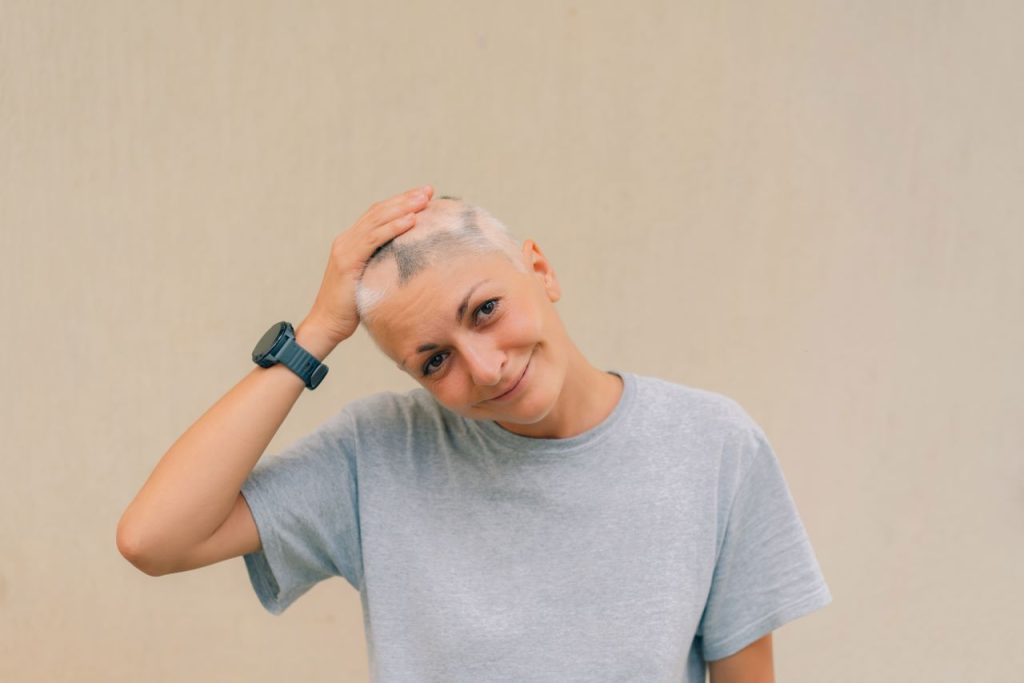
Did you know there are several types of alopecia? It may be often used as a blanket term for hair loss, but alopecia describes a number of conditions with very different underlying causes. Alongside androgenetic alopecia, scarring alopecia, chemotherapy-induced alopecia (known officially as anagen effluvium), telogen effluvium and traction alopecia, alopecia areata is one alopecia type that you should be aware of.
While not the most common – androgenetic alopecia or pattern baldness is the most frequent cause of hair loss in men and women – alopecia areata causes devastating side effects that can lead to recurrent or even permanent hair loss.
Read on to find out more about the signs, symptoms and treatment options for alopecia areata…
Unlike some types of hair loss, alopecia areata is not related to diet or other lifestyle preferences. It is thought to be exacerbated by stress, although evidence to prove this connection is rather limited. What we do know is that alopecia areata is an autoimmune condition.
Here the British Association of Dermatologists (BAD) explains more about how the immune response of alopecia areata sufferers triggers hair loss and thinning:
“Hair loss in this condition is caused by inflammation of the hair follicle. Studies have shown that our immune system, the natural defence which normally protects the body from infections and other diseases, mistakenly attacks the hair follicle, stopping it from growing hair. The exact cause of why this happens is still not fully understood.”
Some individuals are more at risk of developing alopecia areata than others. You are for instance more likely to suffer from alopecia areata if you have a family history of the condition. Those with conditions like thyroid disease, vitiligo, type 1 diabetes and even atrophic issues (like eczema, asthma and allergies) were also found to be at greater risk of developing alopecia areata.
Alopecia areata affects just as many men as women, regardless of their race or ethnicity. It can develop in children too.
Hair loss is the main symptom of alopecia areata. Related hair loss typically develops in patches, although they are subsets of alopecia areata that cause total scalp baldness (alopecia areata totalis) or complete hair loss across the scalp, face and body (alopecia areata universalis).
Those with alopecia areata may also experience intense itching or burning, or the growth of grey or white hairs in the affected areas. Nail pitting and lesions are common among alopecia areata sufferers, especially those who are younger in age.
Unfortunately, there is no cure for alopecia areata, but symptoms can be treated using a variety of options to improve comfort and stimulate hair growth. Topical treatments like minoxidil, anthralin, immunotherapy and corticosteroid creams offer good results. While steroid injections are effective for those with mild alopecia and patchy hair loss.
Oral treatments – such as cortisone tablets, janus kinase (JAK) inhibitors and immunosuppressants – should be administered with caution. Oral immunosuppressants are not suitable for people with high blood pressure, liver and kidney damage, or an increased risk of infection or lymphoma. Laser treatment and natural remedies are also commonly used to treat alopecia areata.
The unpredictable nature of alopecia areata means many people find better results by learning to live with alopecia – read our guide on the very subject here. You should also check out our range of wigs and hairpieces to find coverage that gives you confidence on a daily basis.
